


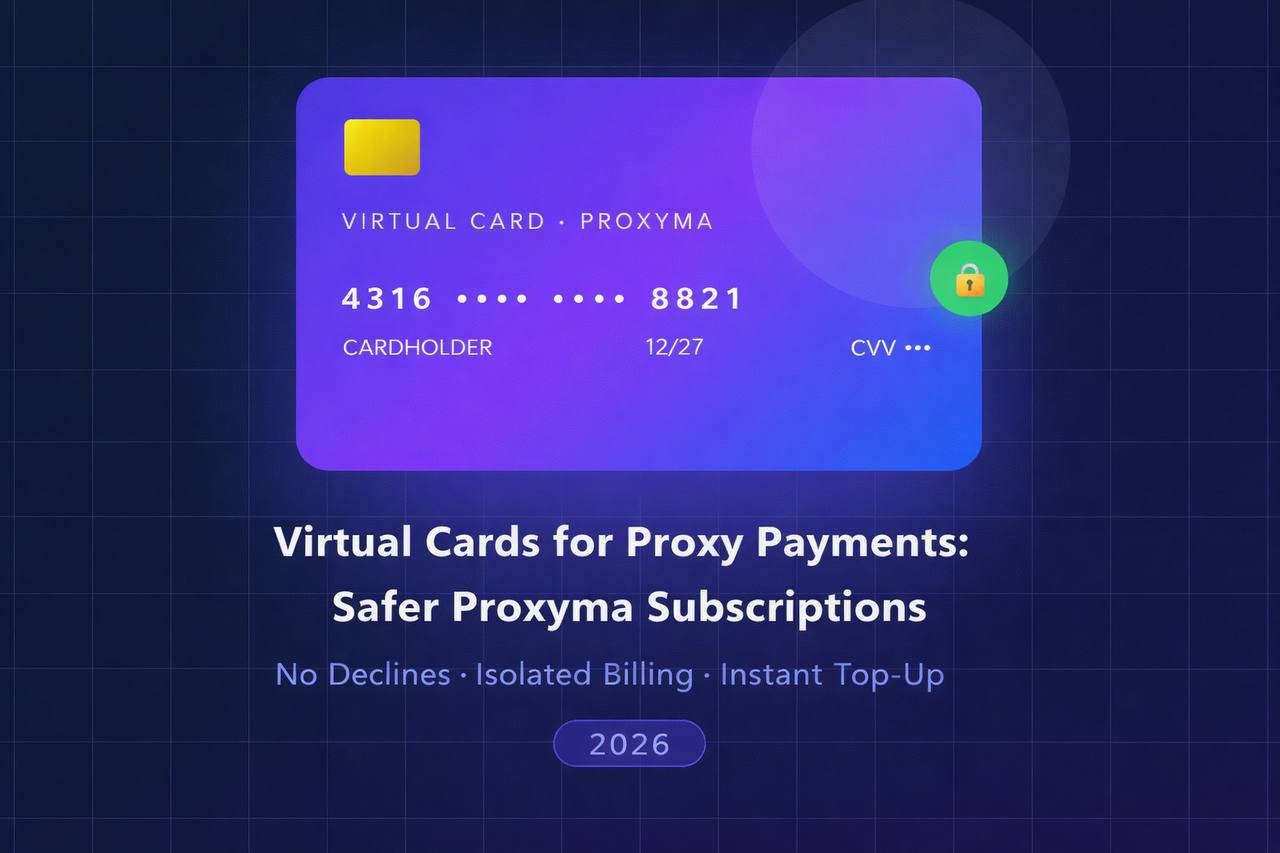

How to Pay for Proxy Subscriptions Safely: Virtual Cards for Proxyma and Team Workflows
If you run ads, manage multiple accounts, or buy residential proxies for automation and scraping, payment reliability matters as much as IP quality. A single card issue can interrupt campaigns, pause data collection, or break a workflow that depends on Proxyma proxies. That’s why more teams are switching to virtual cards for proxy payments—separating vendor subscriptions from the company’s main funding sources and reducing operational risk.
In this guide, you’ll learn how virtual cards help you pay for Proxyma plans and similar SaaS subscriptions with fewer failures, cleaner accounting, and tighter spend control—especially for agencies and distributed teams.
Register and activate your card now :https://vmcardio.com/en/usercase-adspayment
Why proxy subscriptions get declined (and why it’s not always your fault)
Proxy services are commonly used by performance marketers, e-commerce operators, and data teams. Many payment systems treat these purchases as “higher risk,” which can lead to:
- Random declines and “do not honor” responses
- Forced 3DS checks or verification loops
- Merchant retry attempts triggering issuer suspicion
- Card freezes due to unusual cross-border patterns
- Account-level disruption if your “main card” is linked everywhere
Even if your use case is legitimate (ads, QA testing, geo verification, market research), the payment profile can still look unusual: recurring charges, cross-border billing, and frequent tool purchases.
H2: What a virtual card changes (the practical benefits)
A virtual card is not just “a card number.” Used correctly, it becomes a control layer for subscriptions like Proxyma.
Key benefits for proxy payments:
- Isolation: each vendor gets its own card, so a dispute/decline won’t affect other tools
- Spend caps: limit exposure if a billing error happens
- Cleaner bookkeeping: map each card to a project, client, or department
- Faster replacement: if something flags, rotate the card without touching your main funding setup
- Team operations: issue multiple cards for buyers while keeping centralized oversight
For ad teams, this is the same logic as separating ad account assets: you don’t want one fragile dependency to take down your whole stack.
A simple setup that works for agencies and growth teams
Here’s a proven structure for teams paying for proxies + antidetect browsers + ad tooling:
Step 1: Create a “Vendors” wallet and funding routine
Keep a dedicated balance for subscriptions. Fund it on a schedule (weekly or biweekly) so renewals don’t fail mid-campaign.
Step 2: Issue one virtual card per vendor (not one card for everything)
Examples:
- Card A: Proxyma subscription
- Card B: Anti-detect browser license
- Card C: SMS/phone verification provider
- Card D: Cloud/VPS spend
This prevents a problem at one merchant from impacting the rest.
Step 3: Add labels and owners
Use labels like “Client-01 / Proxy Stack” or “Media Buying / Proxies.” If multiple buyers exist, assign responsibility per card.
Step 4: Set limits and rules
At minimum:
- Monthly cap = expected subscription price + buffer
- Per-transaction cap to avoid unexpected spikes
- Optional: freeze a card when not in renewal windows (if your platform supports it)
Step 5: Track renewals like uptime
Proxy availability is operational uptime. Treat subscription renewals as part of your production reliability checklist.
Where Vmcard fits (and why it’s commonly used for this)
Vmcard is designed for cross-border spend scenarios like subscriptions, cloud services, and advertising payments. For proxy subscriptions, teams typically use Vmcard because it supports:
- Multi-card issuing for separate vendors/projects
- Centralized visibility into transactions
- Fast funding for time-sensitive renewals
- Spend-only usage (dedicated for payments; not for receiving funds)
If your workflow includes Proxyma residential proxies for scaling accounts or collecting data, a dedicated virtual card for Proxyma makes the subscription side more stable and easier to manage.
Best practices to reduce declines and interruptions
Use these operational habits to minimize payment failures:
- Keep vendor cards “boring”
Avoid using the same card across many unrelated merchants in a short time window. - Match billing details consistently
Use consistent billing profile info across renewals to reduce verification friction. - Don’t run renewals at zero balance
Fund before the renewal date to avoid retry loops that create risk signals. - Avoid sharing one card across multiple buyers
More devices + more logins + more billing updates can look abnormal. - Have a backup card ready
One spare card for “Proxy Stack Backup” avoids downtime if something gets flagged unexpectedly.
Proxy + payment reliability = fewer broken workflows
Proxyma is usually bought to reduce blocks, stabilize automation, and improve success rates for geo-targeted activity. But none of that matters if your proxy plan fails to renew during a critical campaign.
A clean “one vendor, one card” model is a small change that prevents a disproportionate amount of downtime—especially for agencies running multiple client stacks.
FAQ
Q1: What’s the safest way to pay for Proxyma proxies for a team?
Use a dedicated virtual card for Proxyma, separate from your main card(s), with a monthly cap and a clear label for accounting.
Q2: Why do proxy subscriptions get declined more often than normal SaaS?
Proxy and automation-related purchases can be classified as higher risk by some payment systems due to cross-border patterns and common fraud associations.
Q3: Should I use one card for all my marketing tools?
It’s possible, but it increases blast radius. One issue can disrupt multiple subscriptions. One card per vendor is safer for operations.
Q4: What should I do if a renewal fails right before a campaign?
Fund immediately, try a backup virtual card, and avoid repeated rapid retries on the same card if your billing keeps failing.
If you rely on Proxyma proxies for stable operations, pair them with a dedicated virtual card for cleaner renewals, better control, and fewer interruptions.